
How Often Should You See a Dentist? Here's the Honest Answer
Written by Silverstone Family Dental — serving Meridian and the Treasure Valley since 2003.
If you are reading this, there is a good chance you are overdue, and you already know it. That is fine. A lot of people are in that same spot.
So the answer for most people is 2 times a year. Every 6 months. That is what the American Dental Association recommends, and it is what we tell most patients here at Silverstone. The reason is pretty simple, actually. Plaque hardens into tartar in roughly that amount of time. Once it hardens, a toothbrush cannot take it off anymore. Only a professional cleaning can do that. Waiting longer than 6 months just means more of it is sitting there. More tartar means more time for cavities and gum problems to get a foothold.
The other thing is that a lot of dental problems do not hurt when they start. A small cavity early on is not something most people feel. Same with gum disease in the beginning. Both of them show up on a routine checkup, though, when they are still small and not expensive to fix. By the time something actually hurts it has usually been there a while.
Now, 2 times a year is not the right answer for everybody. Some people need to come in more often than that. A small group can probably get away with less. The sections below go through how to figure out which one is you.
Some People Actually Need to Come In More Than Twice a Year
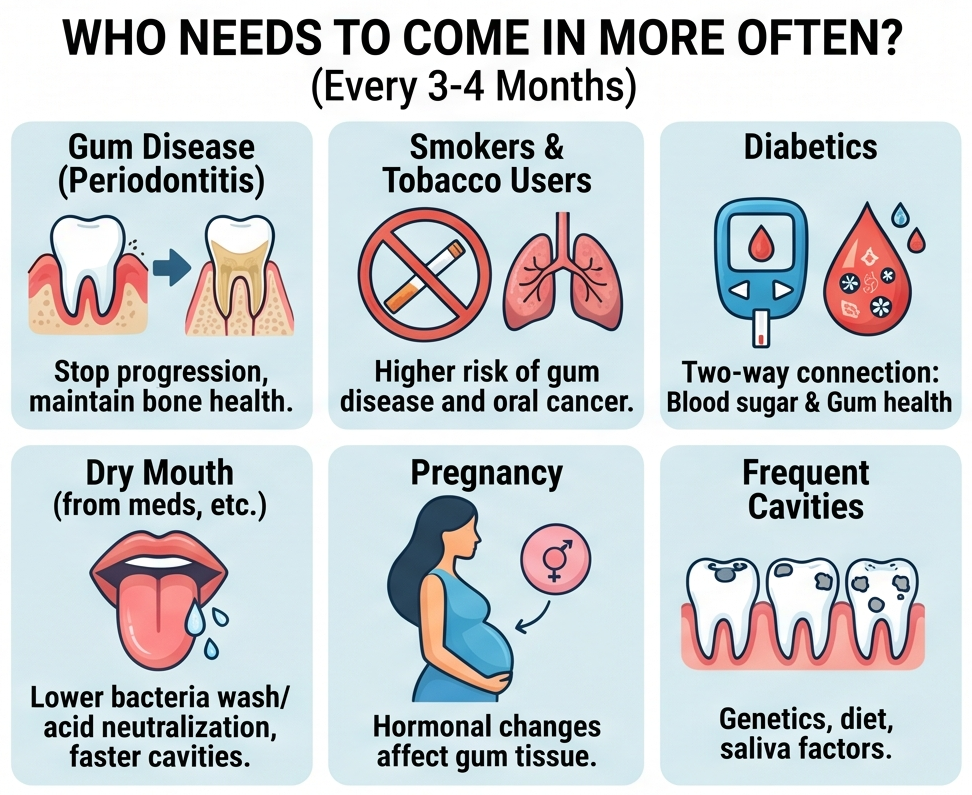
So 2 times a year works for most people, but there are situations where that is just not enough.
Gum disease is the big one. If you have been diagnosed with periodontitis or have a history of gum problems, every 3 to 4 months is usually what we recommend. Gum disease does not just stay where it is if you leave it alone. It progresses. More frequent cleanings help keep it from getting worse.
Smokers and tobacco users fall into this category too. Tobacco use affects gum tissue in a pretty significant way and increases the risk of gum disease and oral cancer. If you smoke or use tobacco, coming in more often gives us a better chance of catching something early.
Diabetics have a higher risk of gum disease than most people realize. The connection between blood sugar and gum health goes both ways, actually. Gum disease can make blood sugar harder to control, and high blood sugar makes gum disease worse. So if you are diabetic, more frequent visits are usually worth it.
Dry mouth is another one. Saliva does a lot of work in the mouth that people do not think about. It helps wash away bacteria and neutralize acids. When there is not enough of it, cavities develop faster. If you have dry mouth from medication or any other reason, your teeth need more attention.
Pregnant women are also in this group. Hormonal changes during pregnancy affect gum tissue and can make gum problems show up or get worse faster than normal. We see this regularly at Silverstone.
And then anyone who just gets a lot of cavities. Some people are more prone to them than others: genetics, diet, saliva composition- it all plays a role. If you have had several cavities in the past few years, coming in every 3 to 4 months gives us a better shot at catching them before they turn into something bigger.
Can You Get Away With Once a Year? Maybe — But It's Not Your Call
This one comes with a big caveat, so bear with it for a second.
There is a small group of adults who genuinely do fine with 1 dental visit per year instead of 2. These are people with a long history of good oral health, no gum disease, no history of frequent cavities, consistent brushing and flossing at home, and low risk factors across the board. For someone like that, some dentists are comfortable seeing them once a year.
The important thing, though, is that this is a decision a dentist makes, not something a patient decides on their own. The people who tend to go once a year because they decided for themselves that they are low risk are usually not the same people who actually are low risk. Cavities and gum disease both develop quietly. You cannot tell from how your teeth feel whether you are overdue for a cleaning or not.
So if you are wondering whether you are someone who can get away with once a year, the honest answer is that the only way to know is to come in and let us take a look. If your history and your current situation support it, we will tell you that. If it does not, we will tell you that too.
Why So Many Meridian Patients Are Overdue — And Why It's Not Their Fault
Meridian has grown faster than almost any other city in the country over the past 10 to 15 years. A lot of the people who live here now did not live here 5 years ago. And 1 of the most common things we hear from newer patients is some version of the same thing. They had a dentist back where they came from, the move happened, life got busy, and somehow 2 or 3 years went by without finding a new one here.
That is probably the single most common reason we see patients who are overdue. Not because they stopped caring, just because the transition got in the way and it never quite made it to the top of the list.
Military families are another big part of our patient base here. Gowen Field and Mountain Home AFB bring many families to the Treasure Valley, and the nature of military life means dental care sometimes falls through the cracks when a move happens or when coverage transitions between military and civilian insurance. We have worked with military families for years at Silverstone, and we know how that process works, including TRICARE, so that part is not something you have to figure out on your own.
Dental anxiety is the other thing that keeps people away longer than they should be. A lot of patients who come to us for the first time in years tell us they knew they needed to come in but kept putting it off because they were nervous about what we might find or about the appointment itself. We hear that a lot, and it does not surprise us. If that is the situation, mention it when you call. We offer sedation options, including nitrous oxide, oral sedation, and IV sedation, and the goal is to make the appointment something you can get through comfortably so you can get back on a regular schedule.
1 more thing worth knowing for Meridian specifically. Meridian receives fluoridated water from Boise's water system. Fluoride in the water supply helps prevent cavities, but it is not a substitute for regular cleanings and checkups. It just means the baseline protection is there for most Meridian residents, which is a good thing.
What Happens at a Routine Checkup at Silverstone
At Silverstone Family Dental, a routine checkup means more than a quick look — here's what actually happens during your visit.
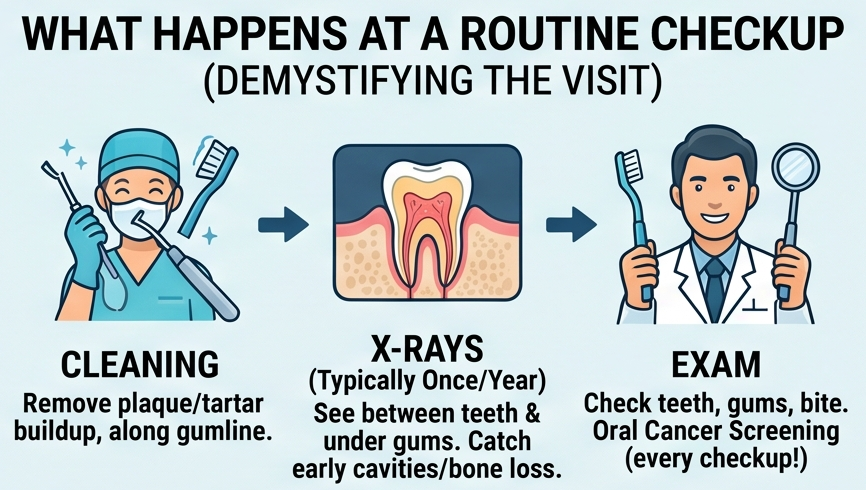
A lot of people who are overdue put it off partly because they are not sure what they are walking into. So here is what actually happens.
When you come in for a routine checkup here, the appointment has a few parts. The cleaning comes first. A hygienist removes the plaque and tartar that has built up since your last visit, cleans along the gumline, and polishes the teeth. This is the part that does the work that brushing and flossing at home cannot fully replicate, no matter how good your home routine is.
X-rays are typically done once a year. Not every visit, just annually, unless something specific comes up that warrants a closer look sooner. X-rays show what is happening between the teeth and under the gumline, places that a visual exam cannot reach. This is usually where early cavities and early bone loss get caught.
After the cleaning, Dr. Hill does the exam. This includes checking each tooth, looking at the gums, checking the bite, and doing an oral cancer screening. The cancer screening is quick, just a visual and physical check of the soft tissue in the mouth, but it is something that gets done at every checkup because oral cancer caught early is very treatable. When caught late, it is much harder to treat.
1 thing worth knowing about Silverstone specifically. Dr. Hill completed 2 years of hospital-based training at UVA after dental school, covering root canals, oral surgery, implants, and complex cases. What that means for a routine checkup is that if he finds something, in most cases he can handle it here rather than sending you somewhere else. A lot of general dentists refer out for root canals or oral surgery. We do not have to do that here, which means fewer appointments and less time dealing with the problem once it gets found.
If you have not been in a while and you are nervous about what the exam might find, that is understandable. Mention it when you call and we will talk through what to expect before you come in.
Kids Need the Dentist Too — Starting Earlier Than Most Parents Think
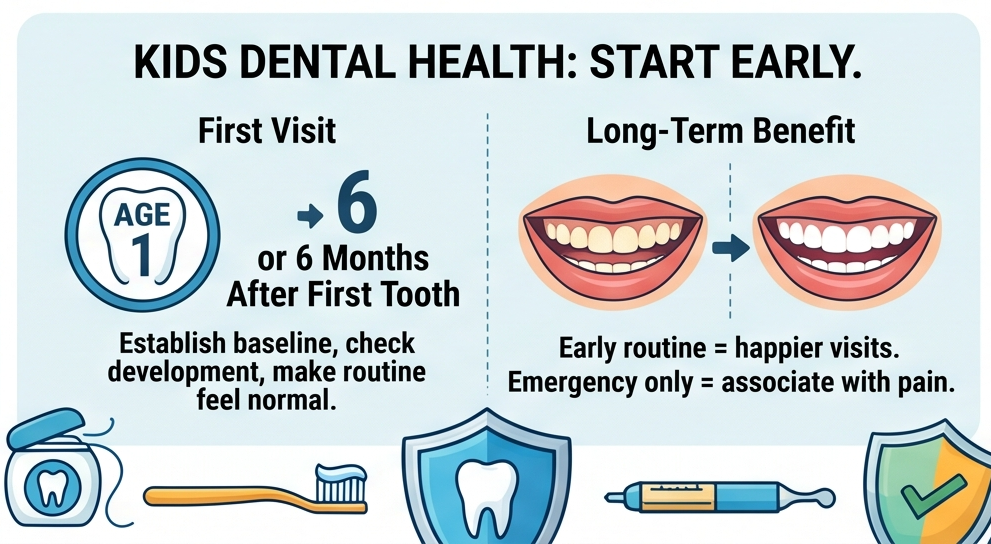
Same answer as adults for most kids. Every 6 months. But the starting point is earlier than a lot of parents realize.
The American Academy of Pediatric Dentistry recommends a first dental visit by age 1, or within 6 months of the first tooth coming in, whichever comes first. That sounds early, and a lot of parents are surprised by it. But the first visit is not really about cleaning; it is about establishing a baseline, checking that development is on track, and making the dentist feel like a normal part of life before there is ever anything wrong to deal with.
Kids who start coming in early tend to have a much easier time with dental visits as they get older. Kids who only go when something hurts associate the dentist with pain, and that association sticks. It is a big part of why so many adults are anxious about dental visits in the first place.
Meridian has a lot of young families, and this is something we see regularly at Silverstone. Parents who bring their kids in early and keep them on a 6-month schedule end up with kids who are genuinely fine with coming in. It becomes routine. And routine means problems get caught early, which means less work and less discomfort for the kid when something does need to be addressed.
If your child has not been in yet and they are past age 1, just call us, and we will get them scheduled. There is no judgment about where you are starting from, just a first visit to see where things stand and go from there.
What Skipping Checkups Actually Costs You
This is the part most people already know on some level, which is probably part of why looking it up felt necessary in the first place.
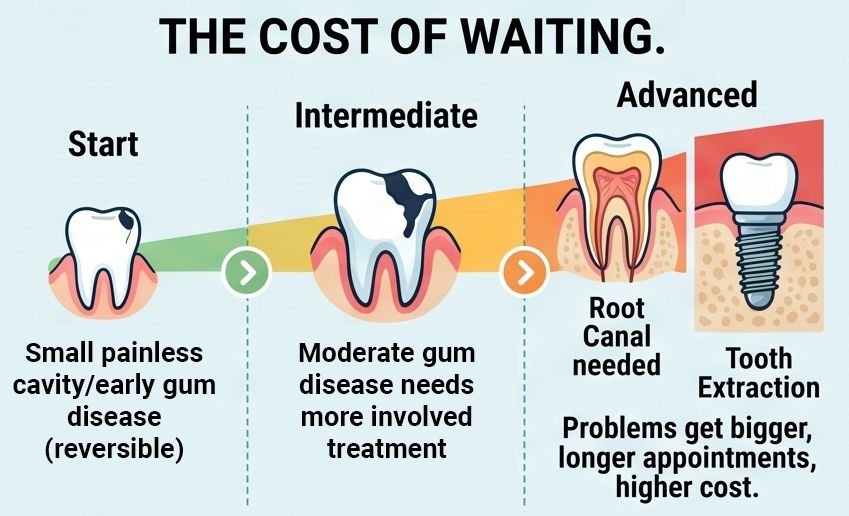
Small problems become big ones when they do not get caught. A cavity in the early stages is a small filling, maybe 30 minutes in the chair and not a big deal. That same cavity left alone for another year or 2 can reach the nerve, and now it is a root canal. A root canal is not the end of the world; Dr. Hill does them here at Silverstone, but it is a longer appointment and a bigger expense than a filling would have been. Leave it even longer, and the tooth may not be saveable at all, and now you are talking about an extraction and an implant or a bridge to replace it.
Gum disease works the same way. Early gum disease is reversible with a professional cleaning and better home care. Moderate gum disease requires more involved treatment. Advanced gum disease causes bone loss and tooth loss, and bone loss is not something that comes back. Once it is gone, it is gone.
The financial side of this is real too. Most dental insurance plans cover 2 cleanings per year at 100 percent. Skipping those covered visits does not save money; it just means leaving paid-for care on the table while problems develop that will cost significantly more to fix later. For patients without insurance, Silverstone's in-office Patient Benefit Program starts at $400 per year for adults and $325 for children under 12, and it covers exams, X-rays, and a 20 percent discount on most procedures. A preventive visit under that plan costs a fraction of what a root canal or an extraction costs without any coverage at all.
The honest version of this is simple. The longer the gap between visits, the more likely it is that something small has had time to become something bigger. Catching it sooner is almost always better, easier, faster, and cheaper than catching it later.
Questions We Hear From Patients Who Are Overdue
Is it OK to go to the dentist once a year instead of twice?
For most people, once a year is not enough. Plaque hardens into tartar in roughly 6 months, and tartar is something only a professional cleaning can remove. Waiting a full year means it has been sitting there longer than it should. There is a small group of adults with genuinely low risk profiles where once a year may be appropriate, but that is a decision a dentist should make based on your specific history, not something to decide on your own.
How often should children go to the dentist?
Every 6 months, same as adults. The first visit should happen by age 1 or within 6 months of the first tooth coming in. Starting early helps establish healthy habits and makes the dentist feel normal to kids before there is ever anything wrong to deal with.
What if I haven't been to the dentist in years?
Come in anyway. This is probably the most common situation we see at Silverstone: patients who have been away for a while and are nervous about what we will find. We do not judge the gap. We just do an exam, tell you what is going on, and put together a plan to get things back on track. The sooner you come in, the better, because whatever is developing has less time to get worse.
Do I still need to go to the dentist if my teeth don't hurt?
Yes, and this is actually one of the most important reasons to go. Most dental problems do not hurt until they are already significant. Cavities in the early stages are painless. Early gum disease is painless. Both of them show up on a routine checkup when they are still small and easy to fix. Pain is a late symptom, not an early one.
How often should I get dental X-rays?
For most adults, once a year is standard. If you have a history of cavities or gum disease, your dentist may recommend them more frequently. X-rays show what is happening between teeth and under the gumline, places a visual exam cannot reach, and that is where a lot of problems start.
Ready to Get Back on Track? Here's How to Start
Whether you are 6 months overdue or 6 years overdue, the best move is just to come in. Dr. Hill has been on Eagle Road in Meridian for over 20 years and has seen every situation there is. There is no judgment about where you are starting from, just an honest look at where things stand and a clear plan to get them where they need to be.
If anxiety has been part of what kept you away, mention it when you call. We have nitrous oxide, oral sedation, and IV sedation available, and we will have the right option ready before you arrive.
Most insurance plans are accepted, including TRICARE. No insurance? Our in-office Patient Benefit Program starts at $400 per year for adults and $325 for children under 12, and it covers exams, X-rays, and a 20 percent discount on most procedures.
Call (208) 943-2265 or stop by at 2026 S Eagle Rd, Meridian, ID 83642. Monday and Tuesday 8am to 5pm, Wednesday 7:30am to 4pm, Thursday 7:30am to 5pm.